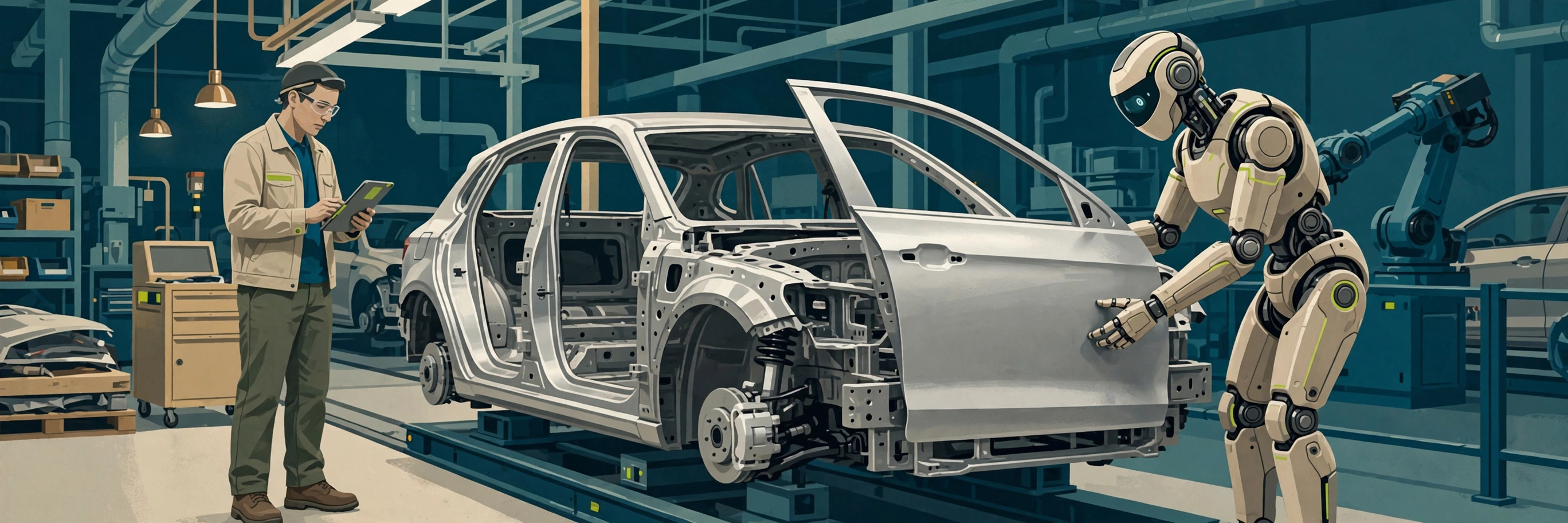
Walk into a car factory today and you might see one: a robot with a head, two arms, and two legs, moving parts down the line. The videos look like the future. So here’s the question a lot of people are asking: are robots about to become car mechanics?
The straight answer, as of October 2026: no humanoid robot anywhere is working as an actual car mechanic. None is diagnosing a fault, turning a wrench, changing oil, or servicing a customer’s car in a repair shop. What exists is real — but it’s on the factory floor, not in the service bay. And the gap between those two places is exactly where human judgment still rules.
Where humanoids actually work today
The car companies aren’t testing humanoids in repair shops. They’re testing them in factories, on repetitive jobs:
- BMW (South Carolina) — Figure AI’s Figure 02 robot spent 10 months positioning sheet-metal parts for welding. BMW reports it moved more than 90,000 components and contributed to production of over 30,000 X3 vehicles. A newer Figure 03 returned in June 2026 for logistics work.
- Mercedes-Benz (Germany and Hungary) — Apptronik’s Apollo robot is trialing in intralogistics: moving totes and kits between stations and doing early component inspections.
- Hyundai (Georgia, USA) — Boston Dynamics’ electric Atlas is training at Hyundai’s new plant: heavy lifting and parts sequencing in fenced-off zones.
- Renault (Douai, France) — Wandercraft’s Calvin-40, a headless robot with gripper hands, is handling tires live on the line — two tires at a time, about 30 kg.
- Nio and Dongfeng (China) — UBTech’s Walker S does quality inspections: door locks, seat belts, headlights, logo attachment. Oil filling is a stated plan, not a finished result.
- SAIC-GM (Shanghai) — Kepler’s K2 “Bumblebee” appeared in a company video doing bolt-tightening and inspections — a staged test, not verified production work.
Notice the pattern: every one of these jobs is repetitive, low-dexterity, and structured. Move this part there. Check that panel. Carry those tires. Nobody is handing a robot a torque wrench and pointing it at a customer’s car.
What they can really do — and what they can’t
Can do today: precise part handling, moving materials between stations, visual quality inspections, tire handling, parts sequencing — inside fenced zones, on tasks that repeat the same way every time.
Still demo or lab-only: using real mechanic’s tools (torque wrenches, impact guns, screwdrivers), diagnosing a vehicle fault, working under a car or inside an engine bay, and handling anything unexpected. Most of the impressive public videos are programmed or teleoperated — a human is driving behind the curtain.
One telling detail from a 2026 industry investigation: at a Chinese robot training center, trainers needed 50 to 300 attempts to teach a robot a single usable movement, and the robots ran simple tasks at about 20% of human speed.
Why the mechanic’s job is so hard for a robot
A repair shop is just about the hardest workplace imaginable for a robot. Here’s why:
- Hands. This is the binding constraint — engineers call it “the hands problem.” A human hand has 27 degrees of freedom; most robot hands manage simple pick-and-place. Tesla’s robot hand alone is reportedly a quarter of the machine’s cost and half its engineering challenge. Dexterous hands trialed on metal parts at a Renault plant broke within days.
- Torque. Mechanic work means lug nuts and suspension bolts — sustained, controlled force. No humanoid has been shown applying calibrated fastener torque to automotive spec.
- Heat and battery. Robot motors overheat after 2–3 hours of heavy lifting. A shop needs 8–12 hour shifts, back to back.
- Safety around people. A service bay is tight, cluttered, and full of humans. Certified systems that predict what a person will do next don’t exist yet — today’s answer is a laser fence that freezes the robot when anyone steps inside.
- The legs question. Real mechanic work means kneeling, crawling under vehicles, reaching into engine bays. No industrial humanoid has demonstrated any of that — and several manufacturers are quietly switching to wheels instead of feet.
What this means for the human leader
Here’s the pattern to see: robots take the repetitive; humans keep the judgment. The factory deployments prove the first half. The empty repair shops prove the second.
The mechanic of the future won’t compete with a robot for who can move parts faster. That race is already lost, and it doesn’t matter. The mechanic of the future will be the person who diagnoses what the robot can’t, handles what the robot breaks, and answers for the result — the leader in the loop.
Human Authority → AI Assistance → Human Verification → Human Decision
Direct it. Check it. Question it. Decide.
Every advance in robotics is an advance in the need for people who can direct machines wisely and stand behind the outcome. The robots are coming to the factory floor. The judgment still walks in on two human legs.
References
- BMW Group press release, 2026 — Figure robots in production at Spartanburg. press.bmwgroup.com
- UrduPure, Aug 30, 2026 — “Blue-collar bots: humanoid robots have reached the factory floor.” urdupure.com
- Interesting Engineering, Apr 2025 — Kepler K2 “Bumblebee” at SAIC-GM Shanghai. interestingengineering.com
- Interesting Engineering — UBTech Walker S at Dongfeng/Nio. interestingengineering.com
- Automotive News via repairerdrivennews, Sept 24, 2026 — Toyota’s $6.4B/yr humanoid plan. repairerdrivennews.com
- humanoid.guide, Sept 9, 2026 — Humanoid Robots Summit 2026, Stuttgart: field notes. humanoid.guide
- Reuters investigation (via Notebookcheck), Aug 27, 2026 — China’s humanoid industry: the training-data bottleneck. notebookcheck.net
- TechCrunch, Sept 23, 2026 — PitPro’s tire-changing robot goes live in Calgary (non-humanoid automation doing real mechanic work). techcrunch.com
Company-reported figures (BMW’s parts counts, vendor demo claims) come from the companies themselves and lack independent audit. Research compiled October 1, 2026.